


Copy editing, Copywriting

5 simple ways to improve your copy

Writing is a skill that’s fairly easy to learn: the trick is to keep things simple. Inexperienced writers will often over-complicate things in a bid to sound impressive. In fact, the more skilled the writer, the cleaner and clearer the copy will be.

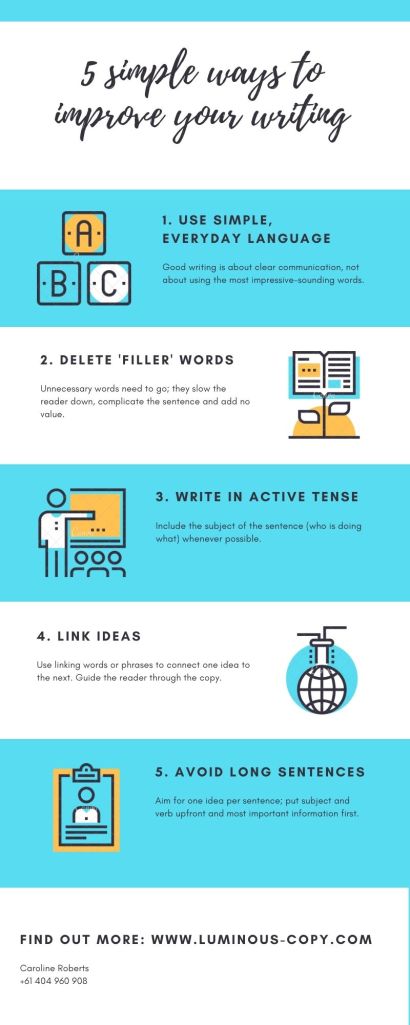
Here are five simple writing hacks for better communication:

  1. Use simple, everyday language

If you’re writing in a professional context, your intent is to communicate. Therefore, you need to use words and phrases that are known and used by your readers. Your audience wants to move through your content quickly and efficiently. 

Certainly, there’s nothing more disengaging than not understanding what you’re reading. In your readership you will certainly have individuals with different reading abilities, as well as those who have English as a second language. By making things easy, you’ll communicate more effectively.

Choosing commonly used words will also help with your search engine optimisation. You want your keywords and synonyms to reflect what users type into search engines as this will make your content more likely to rank well.

2. Delete filler words

Often if writers are struggling to get their words down, others advise them to write what they would say. This is a good strategy to get started, but follow-on editing is required. Speech is full of grammatical errors, empty words and redundant clauses – and this doesn’t matter; communication also comes through body language, pauses and what’s left unsaid.

However, when writing you don’t have the same luxury; it’s all about the words and they need to be precise and articulate. Most readers have little tolerance for filler words. Verbose phrases should be pared back to allow for quick reading. For example:

  • In conjunction with (‘with’)
  • At this point in time (‘now’)
  • In order to (‘to’)

3. Write in active tense

Whenever possible and sensible, write in the active tense. This means being clear about who is doing what. So rather than, ‘You will be contacted within three business days’, write ‘One of our sales consultants will contact you within three business days.’

If a business uses the passive tense too much, the writing becomes vague. This lack of transparency makes the company’s processes and practices look woolly, undermining credibility.  

4. Link ideas

Each sentence should flow neatly and logically from its predecessor. Sometimes this happens naturally, other times the writer may need to create a ‘bridge’ between one idea and the next. This linkage could be a simple word or phrase, such as: furthermore, likewise, this means, as a result. Similarly, it could be a clause that builds on the previous idea, such as: ‘Another marketing tactic that we’re using is…’

These ‘signposts’ at the start of a sentence help the reader navigate the text, aiding effective communication and understanding.  A good writer guides the reader through the text, ensuring they don’t get lost along the way. 

5. Avoid long sentences  

Long sentences have plenty of room for error: they tend to include multiple clauses and can lose sense completely if they have less than perfect grammar. Often the subject of the sentence (the agent of the action) can get buried in complicated language constructions, so it becomes unclear what the clause is referring to at all!

Generally, it’s best to keep things simple. This means strive for one idea per sentence, have the subject and verb of the sentence upfront, and put the most important information first. Make the statement and then substantiate it with another sentence. For example: ‘Sales are down 25% in Q3. This is because of XYZ’. 

Written as one sentence, ‘Because of XYZ, sales are down 25% in Q3’, there’s a risk of losing the reader in the detail of XYZ before you even get to your key message that sales are down.  

To find out more and for copywriting and copy editing support, contact Caroline Roberts on 0404 960 908 or caroline@luminous-copy.com 
Copywriting

What does a business copywriter do?

A business copywriter writes words that help you win business. By helping you communicate with your target market in a way that truly connects, a business copywriter will help you build your brand, deepen your customer relationships, and win new contracts.

Working on your copy

A business copywriter will make sure your words make sense – that your sentences flow cleanly and carry meaning effectively. Similarly, they’ll check that your grammar is correct. This may seem pedantic, but grammar helps the reader to successfully navigate the text.

More than just finding the weak points in your writing though, a business copywriter will actively add to and improve your copy. They’ll help you articulate what you want to say. They’ll understand what you’re getting at and will re-write, if necessary, to make things clearer. 

They’ll also write new content for you based on interviews with you and material you supply. Of course, they can’t know your business like you do; but they do know how to present your product or service in a customer-focused and professional way for maximum sales and marketing impact.  

An outsider’s perspective

Another point-of-view is often very valuable; an outsider can suggest things that you haven’t thought of, which could open up new possibilities and revenue streams. Certainly, a business copywriter will add value by pointing out anything that doesn’t quite make sense to them. They’ll also highlight any assumed knowledge that the reader may not, in fact, have. Clearly, there’s nothing less engaging than not understanding what you’re reading!

Further, a business copywriter will push you to do better: to back up what you’re saying with evidence, graphics, photographs, testimonials and more. With the benefit of working across industries and seeing how different companies approach the same issues, they can advise you on best practice. This saves you from doing the research yourself or learning through trial and error.

What does a business copywriter do?

I work on all types of sales and marketing, business development and compliance material, helping you to present your business in the very best light. My expertise includes:

  • marketing communications, 
  • white papers, 
  • annual reports, 
  • tenders and proposals, 
  • award entries, 
  • grant applications and more.

For help with your business copywriting, contact Caroline Roberts on caroline@luminous-copy.com or 0404 960 908.

Copywriting, Marketing

Content marketing that connects

Often business owners intuitively ‘get’ social media. They can be themselves and engage with their audiences naturally. Communication is authentic and they can build a loyal following which leads to increased sales and referrals.

But with other forms of communication like EDMs and web copy, business owners can come unstuck. Unsure how to market themselves in these channels, their language can become stiff, formal and a barrier to engagement.

This is where you may see grandiose and unfounded statements, such as: “We’re Australia’s number one provider of XYZ”. Of course, that’s great if it’s true but all such claims need to be substantiated with evidence. Otherwise it all sounds rather hollow, boring and, most significantly, rather disconnected from the customer and their buying experience.

Know your customers’ needs

The key to strong content marketing is to know your customer and their needs, and have a definite service offering that delivers for them. This means no “we look to provide…” statements: you either provide something consistently or you don’t mention it. Content should be focused on what clients gain through doing business with you.

It’s worth considering what factors influence your customers’ buying decisions. For example, it could be your product range, service, price, value for money, quality, reliability, results, convenience, style, creativity – or something else entirely. Having a clear customer value proposition will guide your content writing, making marketing easier.

The trick is to fully understand who your target market is and what their pain points are, and then ensure that your business provides solutions to these customers. It takes a mental shift to step outside of your business and take on the perspective of your customers or prospects, but it’s one that gets results. In essence it’s not about you, it’s about your customers.

Help business clients win business

The same is true for business-to-business marketing; you need to communicate very clearly what you offer that company and how they will benefit from working with you. Their ultimate goal is, of course, to sell; so how specifically will your business help them achieve this? Rather than by talking about how great your business is, you need to make a compelling case as to why this firm should work with you.

To find out more, or for help with your business-to-consumer and business-to-business marketing copy, contact Caroline Roberts on 0404 960 908 or caroline@luminous-copy.com

Award writing, Copywriting

Help writing an award entry

Winning an industry award is really great for business. Not only will you enjoy the status and kudos of being best in class, but you’ll also enjoy these added benefits:

  • Customer loyalty – Everyone likes to be on the winning side. Customers feel validated that they’ve had the good judgement to choose your business. They’re more likely to continue to buy from you and to tell others about you.
  • Employee engagement – Most people want to work in a dynamic workplace where they can learn from the best. When they see their efforts paying off, their commitment strengthens and productivity increases. You’re also more likely to attract quality candidates.
  • Publicity – An award win is a great marketing tool. You may be able to use decals on your business premises or award insignia on your website, social media, email signatures and more. Local media may also be interested in your story. Public acclaim provides a great platform for bringing new customers to your company.
  • Networking – Most award programs culminate in a gala award night. This presents a prized opportunity to meet others in your industry or locality – perhaps opening up new opportunities for sales, collaboration or mentorship. Mixing with the best in the field boosts your personal and business brand.

It’s not easy!

The only problem is, the entry process is rarely easy. It takes a lot of time, effort and commitment to pull together a submission. And for no sure outcome. The trick is to tell a story because that’s what people connect with emotionally and intellectually. But the typical question and answer format can make this problematic. 

Each question has specific criteria that the judges want addressed. Therefore, to score well you need to give them what they’re looking for, but you also need to tell your story – what you’ve achieved and what sets you apart. With responses usually having strict word/character limits, it often takes a skilled writer to tell the story in a concise and compelling way within the framework provided.

Get a head start

The secret to success is preparation. It’s worth looking ahead and researching what award programs are available to you over the coming year. Think about your chances of success -and the showcase a particular award program would offer – to decide whether an entry is worth the effort. 

Each award entry needs supporting evidence. This could be year-on-year sales increases, customer satisfaction survey results, feedback/testimonials from clients and staff, engagement on social media or many other metrics relevant to your business. Ideally make this type of measurement a part of your regular practice, so you always have the data to hand.  

The final tip is to engage a busines copywriter; they will save you time and ensure your entry is as brilliant as it can be. The upside if you win is of course significant, but even coming out as a finalist will earn you many of the same benefits as winning. You may also be able to re-use some of the writer’s words for other marketing purposes, increasing your return on investment.

For help writing award entries, contact Caroline Roberts on 0404 960 908 or caroline@luminous-copy.com